
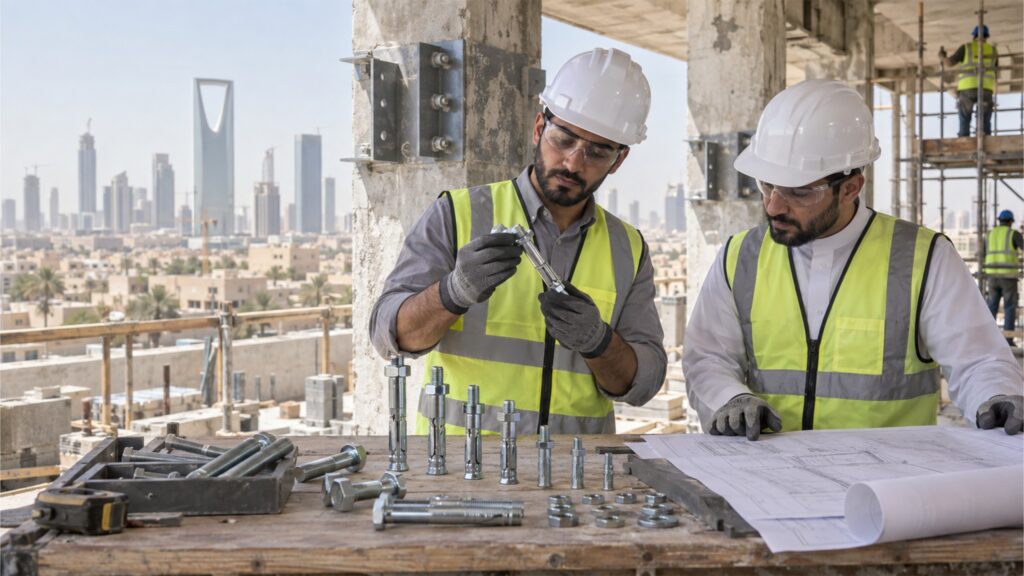
Riyadh’s skyline is changing fast — but not all of the change is new construction. Across the city, older commercial towers, government buildings, and residential blocks are being retrofitted to meet modern safety codes, energy standards, and structural demands. Renovation work brings its own set of engineering puzzles, and one of the most overlooked is fastener selection. Unlike a new build where everything is specified from a clean set of drawings, retrofit work means matching new hardware to existing, often undocumented, structural conditions. Get it wrong, and you’re looking at loosened anchors, coating failures, or a structural connection that simply can’t carry the load it was meant to.
New construction gives engineers control over material specs from day one. Retrofit and renovation work doesn’t offer that luxury. Contractors are often connecting new steel to concrete that’s decades old, working around embedded rebar they can’t see, or trying to match load paths designed under building codes that have since changed. The fastener isn’t just a component here — it’s the point where old and new structural systems have to agree with each other.
This is why sourcing from reliable Fasteners Suppliers in Riyadh Saudi Arabia matters more on a retrofit job than almost anywhere else. A supplier who can walk through substrate condition, load type, and exposure with you — rather than just filling a purchase order — saves rework down the line.
Before any fastener gets ordered, the existing structure needs to be understood, not assumed. Concrete that’s 20 or 30 years old may have carbonated surfaces, micro-cracking, or inconsistent strength across a single slab. A core sample or a simple pull-test on a sacrificial anchor tells you far more than the original as-built drawings, which may not even reflect what was actually poured.
This matters most when selecting anchors for retrofit connections. Older concrete can behave unpredictably under drilled expansion anchors if the material has degraded. In these cases, chemical or adhesive anchors sometimes outperform mechanical types because they don’t rely on outward pressure against potentially weakened concrete. Where mechanical anchors are still the right call, Wedge Anchors Suppliers in Riyadh Saudi Arabia should be able to provide load-rating documentation specific to the anchor diameter and embedment depth you’re planning — not generic catalog numbers.
A building undergoing renovation often gets a longer service life than it was originally designed for — which changes the corrosion-protection math. If HVAC upgrades, water systems, or facade work introduce new moisture exposure that wasn’t part of the original design, the corrosion protection on your fasteners needs to reflect the building’s new reality, not its old one.
This is especially relevant for rooftop equipment mounts, exterior cladding retrofits, and any structural steel exposed to Riyadh’s heat and dust cycles. Hot-dip galvanizing remains the standard for exterior and semi-exposed retrofit connections because the coating thickness holds up to years of thermal cycling better than lighter finishes. Working with established HDG Bolt Suppliers in Riyadh Saudi Arabia means you’re getting coating thickness that’s actually been tested against ASTM or equivalent standards, rather than a thin dip that looks right on delivery but degrades within a couple of seasons.
Some renovation projects go beyond surface-level upgrades — adding a mezzanine floor, reinforcing a foundation for new equipment loads, or extending a structure horizontally. These jobs bring foundation bolts back into the conversation, even on a project that isn’t “new construction” in the traditional sense.
The challenge here is that foundation bolt placement in a retrofit context often has to work around existing footings, utility runs, or slab thickness that wasn’t designed with future expansion in mind. Custom lengths and diameters come up more often than in new builds, where standard sizing usually covers the job. Foundation Bolts Manufacturers in Riyadh Saudi Arabia who can produce non-standard lengths on request, rather than only stocking catalog sizes, give retrofit contractors a lot more flexibility when the as-built conditions don’t match the drawings.
A few habits separate smooth retrofit jobs from ones that stall out mid-installation:
Retrofit and renovation work asks more of fastener selection than new construction does, simply because so much of the existing structure is unknown until you’re on site with a drill in hand. Understanding substrate condition, matching corrosion protection to the building’s extended lifespan, and staying flexible on sizing for foundation-level changes are the habits that keep these projects on schedule. Riyadh’s renovation pipeline isn’t slowing down, and contractors who treat fastener selection as an engineering decision — not an afterthought — are the ones who avoid callbacks and structural surprises after handover