
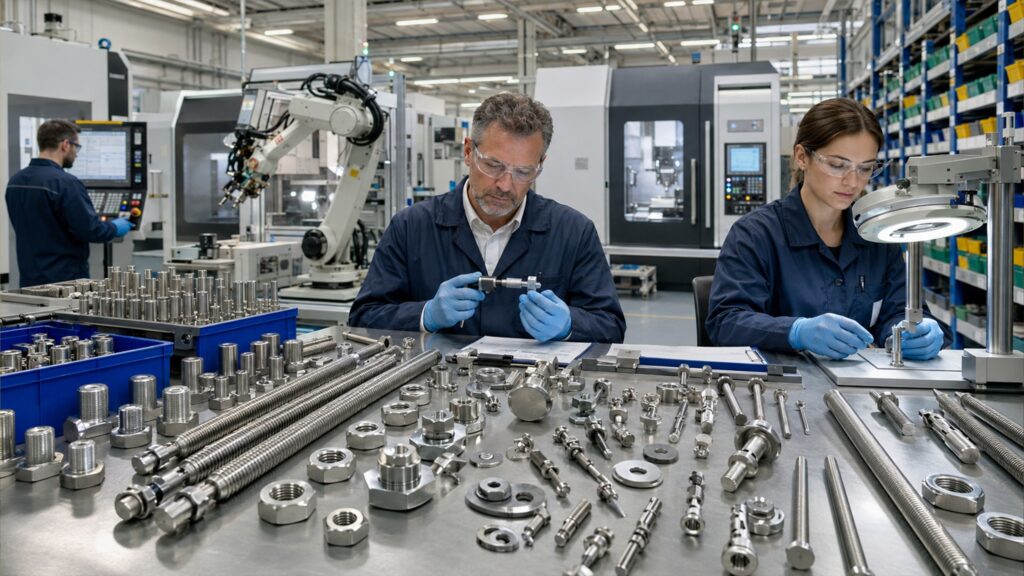
Ask a structural engineer what they check first when qualifying a new fastener supplier, and the answer is rarely the price sheet. It’s whether that supplier holds ISO 9001 certification. For a component as small as a bolt, that single certification carries an outsized amount of trust and understanding why requires looking past the acronym to what it actually verifies.
ISO 9001 isn’t about the bolt itself it’s about the process behind it
A common misconception is that ISO 9001 certifies the fastener’s mechanical properties its tensile strength, its thread tolerance, its grade. It doesn’t. ISO 9001 is about how a supplier’s processes are managed, not the geometry of the fasteners themselves. Mechanical performance is governed by separate standards entirely. What ISO 9001 verifies instead is whether a manufacturer has a consistent, documented quality management system the kind that catches problems before a defective batch ever leaves the factory floor.
In practical terms, that means incoming materials get inspected against defined criteria, production processes are documented and followed consistently rather than done from memory, and nonconforming parts are identified and contained before they reach a customer. It also means equipment calibration, operator training, and customer requirements are all built into a repeatable system rather than left to individual judgment on a given day.
Why this matters more for fasteners than it might seem
Fasteners look interchangeable on a spec sheet, but small inconsistencies in manufacturing a slightly off thread tolerance, an inconsistent coating thickness can be the difference between a bolt that performs for twenty years and one that fails under load. Buyers in construction, machinery, and other regulated sectors increasingly require verifiable quality and traceability precisely because a fastener failure downstream can trigger liability that far outweighs the cost of the component itself. ISO 9001 helps fortify a manufacturer’s defenses against product liability claims tied to fastener failures, while also improving eligibility for premium, higher-value contracts.
What it looks like in day-to-day production
For a fastener manufacturer specifically, ISO 9001 is often used to standardize thread rolling and coating inspections, so that shank diameters and grip lengths consistently meet global specifications. The certification pushes continuous improvement through regular internal audits, which over time reduces rework and scrap savings that, in a competitive market, often get passed along to buyers in the form of more reliable lead times.
It’s not a one-time badge it’s an ongoing commitment
Unlike a certificate a company earns once and files away, ISO 9001 requires annual surveillance audits and a full recertification audit every three years, with continuous improvement built into the standard itself rather than treated as optional. That ongoing scrutiny is exactly what gives the certification its credibility a supplier can’t simply pass an audit once and coast on it indefinitely.
What buyers should actually do with this information
Holding the certification is only useful if it’s verified. Buyers should check that fasteners are labeled with the relevant certifications and work closely with suppliers to confirm the documentation actually matches what’s being delivered. Even with certification in place, it’s still worth conducting independent testing and inspection, particularly for mission critical applications where failure isn’t an option.
ISO 9001 doesn’t test a bolt’s strength it tests whether the company that made it can be trusted to make the same quality bolt, batch after batch, indefinitely. For buyers sourcing fasteners for structural, industrial, or load bearing applications, that consistency is often worth more than any single spec on a data sheet.
for more wisite Ellora one